TenantCloud
- 4.1
- Rating
- 10.00K
- Installs
- Free
- Price

 Analysis by App-foxy
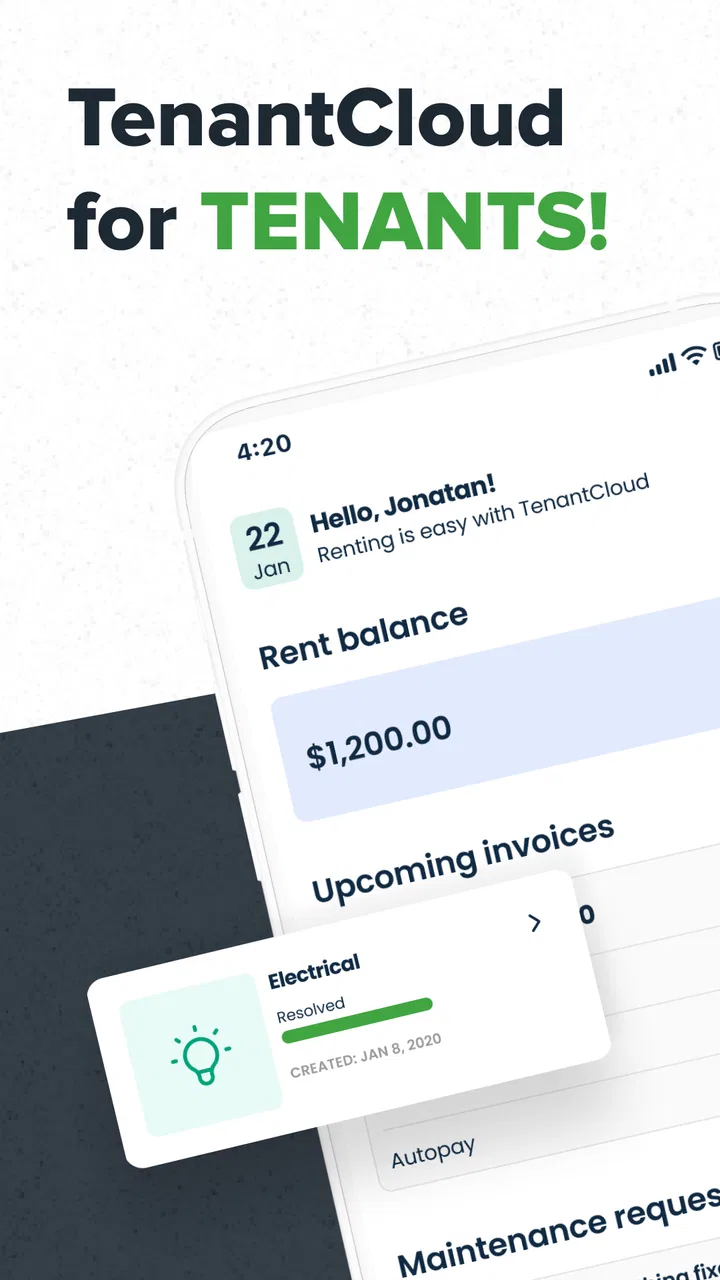
TenantCloud is a practical house and home app for people who rent, and my overall impression is that it works best as a central place for keeping the tenant side of renting organized. It is free, aimed at Everyone, and made by TenantCloud LLC. Rather than treating it like a general property-search tool or a social app for home life, I see it as a companion for the everyday responsibilities that begin after you have a rental relationship in place.
That distinction matters. A tenant usually has to keep track of more than the monthly payment: messages, maintenance concerns, important property details, and the small decisions that become stressful when they are scattered across email, text messages, paper notes, and memory. An app designed specifically for tenants can reduce that scatter. In my experience, that is the main reason to try TenantCloud: it gives rental-related tasks a more natural home than a collection of unrelated phone apps.
The app has reached a 4.5 average from around a thousand ratings, with more than 10,000 installs. Those figures suggest that it has found a useful place among renters, while the review volume also tells me to judge it as a focused tool rather than a universally established platform. It was released on December 4, 2023, and the current version is 1.20.0, so I would approach it as a relatively young product that may still be refining the experience.
You May Also Like

 AccuWeather: Weather Radar
AccuWeather Review: A Quick, Clear Forecast for Everyday Decisions
For everyday plans, the best forecast is the one you can understand quickly. AccuWeather makes rain timing, radar, and local conditions easy to act on, with a few trade-offs.

 Hill Climb Racing
Why Hill Climb Racing Still Turns Crashes Into One More Run
A tiny car, a bumpy hill and one more upgrade: Hill Climb Racing keeps resurfacing because its simple chaos makes every near-miss feel personal.

 AliExpress - Shopping App
AliExpress Makes Global Shopping Feel Personal, but Shoppers Bear the Risk
AliExpress turns a global marketplace into a pocket-sized discovery engine. Its reach is useful, its shopping loop compelling, and its trade-offs easy to miss.

 Lords Mobile: Kingdom Wars
Lords Mobile Is a Kingdom-Building Routine, Not a Quick Match
A case-by-case verdict on the building, battles, device demands, and social commitments that make Lords Mobile rewarding for some players and exhausting for others.

 PDF Scanner app - TapScanner
TapScanner Makes Paperwork Easier to Capture, Check, and Share
TapScanner makes scanning with a phone feel less like a rescue operation and more like a dependable step in getting work done. Its capture tools are useful, though not flawless.

 Block Blast!
 Shows How Much a Puzzle Game Can Leave Out
A quiet grid game shows why puzzle players increasingly value instant clarity, repeatable skill and low-pressure play—and where the genre still needs to catch up.
More From Our News Desk
View All News


What using TenantCloud feels like in real rental life
The strongest part of TenantCloud is its focus. When an app is built for tenants instead of trying to serve every possible housing need, the language and workflow can feel more relevant. I do not have to reshape a generic notes app or a banking app around renting. The purpose is immediately understandable: open the tenant app when the issue concerns the place I live or the relationship connected to it.
A realistic example is a weekday evening when a kitchen fixture starts leaking. The immediate problem is not just the leak; it is remembering what happened, communicating it clearly, and keeping a record of the request. I would use TenantCloud as the first place to organize that situation, adding the relevant details while they are fresh rather than sending a rushed message and later trying to remember when I reported it.
That workflow has a quiet advantage. Rental problems often become confusing because several conversations happen at different times. A tenant may first mention an issue casually, follow up later, and then need to explain that it has not been resolved. Keeping the matter inside a tenant-focused environment can make the sequence easier to follow. The value is not flashy; it is the reduction of mental overhead.
I also find the app more useful when treated as a routine rather than an emergency button. After moving into a property, I would spend a little time making sure my rental-related information is easy to reach and then return to the app whenever something changes. That habit makes it less likely that an important message, request, or reminder disappears among unrelated phone notifications.
A focused alternative to scattered tools
The usual alternative is not necessarily another rental app. Many tenants use email for communication, a banking app for payments, a notes app for property records, and a calendar for reminders. That approach can work, but it forces the renter to maintain the system personally. TenantCloud’s appeal is that it brings the tenant context closer together instead of asking me to remember which tool contains which part of the rental story.
There is a trade-off, though. A general-purpose notes app can be more flexible, and a direct email relationship can feel simpler when I only need to ask one quick question. TenantCloud makes the most sense when my rental activity benefits from a dedicated home. If I rarely need to contact a property manager and already have a reliable system, the extra app may not feel essential.
I would not compare it directly with a home-design app, a real-estate browsing service, or a budgeting tool. Those products solve different problems. TenantCloud is closer to a tenant workspace: its usefulness depends on whether I want rental tasks to be handled in a purpose-built setting. That makes it more relevant than a generic home app for some renters, but less useful for someone looking for decorating ideas, listings, or a complete financial planner.
Small habits that make the app more useful
My first practical tip is to use consistent wording when recording a problem. Instead of writing “bathroom issue,” I would describe the location, the visible symptom, and when it began. That makes later follow-up easier and creates a clearer personal record. The app cannot replace careful communication, but it can give that communication a dependable place.
My second tip is to separate urgent action from documentation. If there is immediate danger, serious water damage, or another situation requiring rapid help, I would contact the appropriate emergency channel first rather than assuming an app message is enough. TenantCloud is useful for organizing the tenant side of a matter, not a substitute for urgent safety decisions.
A third useful habit is reviewing the app after a conversation rather than relying on memory. If a landlord or property manager gives an instruction, I would make sure the relevant details are captured in the same rental workflow whenever possible. This is especially helpful when the instruction includes a date, access arrangement, or a next step that could otherwise be forgotten.
These habits reveal an important point: the app’s benefit depends partly on how deliberately I use it. It is not magic organization. It becomes valuable when I treat it as the place where rental events are recorded and revisited, not merely as an app I open once during setup.
Where the experience may feel limited
The main weakness is the possibility of dependence on the surrounding rental relationship. A tenant app is most useful when the property-management side of the arrangement supports the same workflow. If communication still happens entirely through another channel, TenantCloud may become one more inbox to check instead of the single place I hoped for.
That is not necessarily a flaw in the app itself, but it affects the real-world experience. Before committing to it as my main rental organizer, I would want to know whether the people responsible for my property actually use the TenantCloud workflow. If they do not, I may still use the app for my own organization, but I should not expect it to replace every established channel.
The other limitation is scope. TenantCloud is not the right choice if I want one app to manage every part of domestic life. It should not be judged as a replacement for a budgeting service, a document-storage system, a calendar, or emergency support. Its focused design is its strength, but that same focus means it will not satisfy someone searching for a broad household dashboard.
I also think new users should allow themselves a short adjustment period. Any rental-management workflow is only helpful if I understand where to look and what belongs there. The current version, 1.20.0, reflects an app that is still relatively early in its life, so I would pay attention to how smoothly it fits my particular rental arrangement rather than assuming it will work identically for every tenant.
Who should install it
TenantCloud is a strong candidate for renters who want a dedicated place for rental communication and organization. It is particularly appealing to someone moving into a new property, a tenant who often loses track of messages, or a person who wants a clearer record of maintenance-related conversations. Students, first-time renters, and people managing a home from a busy schedule may appreciate having a more focused workflow than a mix of texts and notes.
I would also recommend trying it if the property-management side of the rental already uses TenantCloud. In that situation, the app has a better chance of becoming part of the normal relationship rather than remaining a private organizational tool. The free price removes the financial barrier to testing it, which is useful when I am not yet sure whether a dedicated tenant app will improve my routine.
On the other hand, I would skip it if my rental arrangement is extremely simple and already works smoothly through one trusted channel. Someone who only needs to send an occasional message may find that email or messaging is faster. I would also look elsewhere if my priority is finding a new apartment, comparing neighborhoods, planning interior design, or tracking a full household budget. Those needs call for different tools.
Privacy and attention are practical considerations too. Even a useful app adds another place to check and another account to keep current. I would install TenantCloud only if I am prepared to use it consistently. A half-maintained rental record can be more confusing than a simple, reliable system that I actually remember to update.
What I would check before relying on it
Before making TenantCloud my main rental companion, I would test the basic flow with a low-stakes task. I would look at how quickly I can find the relevant area, how clearly I can describe a request, and whether I can return to the information later without hunting through screens. That small trial tells me more than simply installing the app and browsing the first page.
I would also decide what belongs in the app and what should remain elsewhere. Rental communication and property-related follow-up make sense here. Sensitive personal documents, broad financial planning, and urgent safety matters may need separate handling. This boundary keeps the app useful without forcing it to become a complete digital archive of my life.
For people sharing a home, I would agree on one simple rule: decide who records a rental issue and who checks for updates. Without that agreement, two tenants may duplicate messages or assume the other person handled the matter. TenantCloud can support a clearer routine, but the household still needs a clear habit around responsibility.
Finally, I would keep the app updated through the normal app-store process. Since it is a young product, improvements may matter to the day-to-day experience. I would not install it expecting a finished replacement for every rental tool; I would install it because the focused tenant perspective may make my existing routine easier.
My verdict is positive, with a clear condition: TenantCloud is worth trying when I want rental life to have its own organized workspace and when the people connected to my property can participate in that workflow. Its free access, Everyone age rating, and focused purpose make it approachable, while the 4.5 average shows that many users find the idea worthwhile.
What keeps me from recommending it blindly is the dependence on context. The app cannot make an uncoordinated rental relationship coordinated by itself, and it is not designed to replace every household or financial tool. Still, for the right tenant, that narrow purpose is exactly the attraction. I would recommend TenantCloud to a renter who wants fewer scattered conversations and a more deliberate way to manage everyday property matters.
In short, I see TenantCloud as a useful tenant-centered organizer rather than an all-purpose home app. If your rental life already feels messy across messages, notes, and reminders, it is a sensible free experiment. If your current method is simple and dependable, you may not need another layer. For renters who want a dedicated place to keep their housing responsibilities under control, however, TenantCloud offers a focused approach that is easy to understand and potentially valuable in daily use.
FAQs for TenantCloud
01What is TenantCloud and what does it offer?
TenantCloud is a comprehensive property management app designed for landlords, property managers, and tenants. It offers features like online rent collection, tenant screening, maintenance requests, and financial reporting. The app streamlines communication and management tasks, making it easier to keep track of properties and enhance the rental experience for both landlords and tenants.
02Is TenantCloud available on both Android and iOS?
Yes, TenantCloud is available for download on both Android and iOS platforms. Users can access the app through the Google Play Store and the Apple App Store, ensuring compatibility with a wide range of devices. This accessibility allows users to manage their rental properties on-the-go, regardless of their preferred mobile operating system.
03Does TenantCloud support multiple properties and tenants?
TenantCloud is designed to accommodate multiple properties and tenants, making it ideal for landlords and property managers with diverse portfolios. Users can easily add and manage various properties, track different tenants, and handle multiple leases. The app's scalable features ensure that it can grow with your property management needs.
04How secure is the data on TenantCloud?
TenantCloud prioritizes user data security by employing robust encryption and secure servers to protect sensitive information. The app ensures that financial transactions and personal data are handled with the highest security standards. Users can trust TenantCloud to manage their data responsibly, providing peace of mind regarding privacy and security concerns.
05Are there any fees associated with using TenantCloud?
TenantCloud offers a range of pricing plans, including a free basic version with essential features. For advanced functionalities like premium support, additional storage, and more detailed reporting, users can opt for paid plans. The tiered pricing structure allows flexibility, enabling users to choose a plan that best suits their specific property management needs.
Pros
- User-friendly interface simplifies navigation.
- Offers comprehensive property management tools.
- Integration with third-party apps enhances functionality.
- 24/7 customer support is highly responsive.
- Mobile app provides on-the-go access.
Cons
- Limited customization options for reports.
- Free version lacks some advanced features.
- Occasional syncing issues with bank accounts.
- Setup can be time-consuming for new users.
- Tenant screening costs extra.

TenantCloud
Gallery